
GCSE Chemistry MCQ
Updated Sep 2, 2025 · v1.0.1


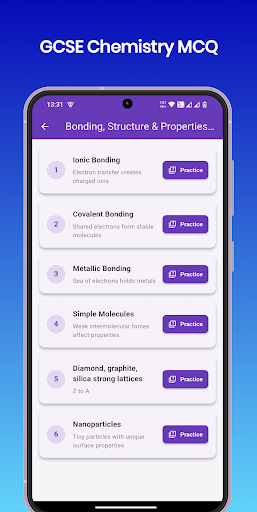


GCSE Chemistry MCQ app for atomic structure, bonding, reactions & more topics
GCSE Chemistry MCQ is a comprehensive practice app designed to help students master key topics in Chemistry through Multiple Choice Questions (MCQs). Perfect for revision, exam preparation, and self-assessment, this app covers all major sections of the GCSE Chemistry curriculum with a clear focus on concepts, applications, and exam-style questioning. Key Features Extensive Question Bank – Hundreds of MCQs covering all GCSE Chemistry topics. Exam-Oriented – Based on latest GCSE syllabus and question patterns. Detailed Explanations – Understand concepts with clear and concise explanation. User-Friendly Interface – Smooth navigation for quick practice and revision. Topics Covered 1. Atomic Structure & The Periodic Table Atoms and Elements – Basic units of matter. Subatomic Particles – Protons, neutrons, electrons. Isotopes – Atoms with different neutron numbers. Electronic Configuration – Arrangement of electrons in shells. Periodic Table Trends – Patterns in groups and periods. Development of Periodic Table – From Mendeleev to modern table. 2. Bonding, Structure & Properties of Matter Ionic Bonding – Electron transfer forms ions. Covalent Bonding – Sharing electrons for stability. Metallic Bonding – Delocalised electrons in metals. Simple Molecules – Weak forces affect properties. Giant Structures – Diamond, graphite, silica properties. Nanoparticles – Unique properties of tiny particles. 3. Quantitative Chemistry Relative Masses – Atomic and formula mass. Moles Concept – Counting particles using moles. Conservation of Mass – Mass remains constant. Balanced Equations – Ratios of reactants and products. Concentration Calculations – Solutions and molarity. Percentage Yield & Atom Economy – Reaction efficiency. 4. Chemical Changes Reactivity Series – Order of metal reactivity. Extraction of Metals – Methods for obtaining metals. Acids and Bases – Neutralisation reactions. Electrolysis – Breaking compounds using electricity. Oxidation & Reduction – Electron transfer reactions. pH Scale – Measuring acidity and alkalinity. 5. Energy Changes Exothermic & Endothermic Reactions – Energy flow in reactions. Energy Profile Diagrams – Energy changes during reactions. Bond Energy Calculations – Energy in making and breaking bonds. Activation Energy – Minimum energy for reaction to start. 6. Rate & Extent of Chemical Change Reaction Rate Factors – Temperature, pressure, concentration. Catalysts – Speed up reactions without being used up. Collision Theory – Effective particle collisions. Reversible Reactions & Equilibrium – Le Chatelier's principle. 7. Organic Chemistry Crude Oil & Hydrocarbons – Source of fuels. Alkanes & Alkenes – Saturated vs unsaturated hydrocarbons. Polymers – Formation and uses of plastics. Alcohols & Carboxylic Acids – Functional groups and reactions. Cracking – Producing smaller hydrocarbons from large molecules. 8. Chemical Analysis Pure Substances & Formulations – Identifying purity. Chromatography – Separation of mixtures. Gas Tests & Flame Tests – Identifying elements and compounds. 9. Chemistry of the Atmosphere Composition & Evolution – How Earth’s atmosphere changed. Greenhouse Gases & Climate Change – Causes and effects. Air Pollution – Sources and impact on health and environment. 10. Using Resources Finite & Renewable Resources – Types and importance. Potable Water & Treatment – Clean water production. Life Cycle Assessments – Environmental impact of products. Recycling & Sustainability – Conserving resources. Haber Process & Fertilisers – Industrial chemistry applications. Why Choose GCSE Chemistry MCQ? Perfect for students, teachers, and tutors. Helps in quick revision before exams. Start practicing today with GCSE Chemistry MCQ and boost your exam confidence!
1 year on Google Play
This app isn't currently appearing in any tracked top charts.