
Zhuangzi: The Book of Zhuangzi
Updated Jul 24, 2026 · v1.0


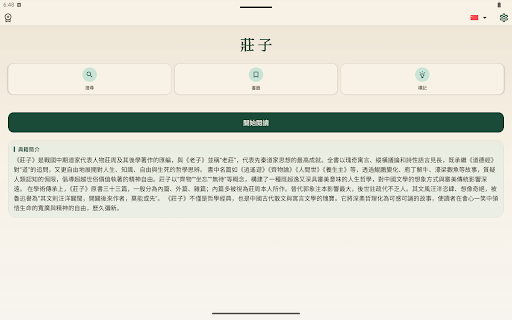


Daoist Classic · Parables and Philosophical Reflections
Zhuangzi is a compilation of writings by Zhuang Zhou, the representative figure of Daoism in the mid-Warring States period, and his later followers. Along with the Laozi, it is known as the "Lao-Zhuang" tradition and represents the highest achievement of pre-Qin Daoist thought. The work is renowned for its fantastic allegories, unbridled arguments, and poetic language. While inheriting the Daodejing's inquiry into the "Way," it unfolds a freer philosophical reflection on life, knowledge, freedom, and death. Famous chapters such as "Free and Easy Wandering," "Discussion on Making All Things Equal," "The World of Men," and "The Secret of Caring for Life" use stories like the transformation of the Kun fish into the Peng bird, Cook Ding carving an ox, and watching fish at the Hao River bridge to question the limits of human cognition and advocate a spiritual freedom that transcends attachment to conventional values. Through concepts such as "making all things equal," "sitting in forgetfulness," and "non-dependence," Zhuangzi constructs a philosophy of life that is both transcendent and deeply aesthetic, profoundly influencing the imaginative modes and aesthetic traditions of Chinese literature. In terms of scholarly transmission, the original Zhuangzi consisted of thirty-three chapters, generally divided into the Inner Chapters, Outer Chapters, and Miscellaneous Chapters; the Inner Chapters are largely considered the work of Zhuang Zhou himself. The commentary by Guo Xiang of the Jin dynasty has been the most influential, and later generations have produced numerous annotations and sub-commentaries. Its literary style is vast and unrestrained, its imagination extraordinary—Lu Xun praised it, saying, "His writing is vast and sweeping, opening up new paths for later writers, none of whom could surpass him." Zhuangzi is not only a philosophical classic but also a treasure of ancient Chinese prose and allegorical literature. It transforms profound philosophy into tangible, memorable stories, allowing readers to grasp the breadth of life and the freedom of the spirit with a knowing smile, remaining ever fresh across the ages.
0 years on Google Play
This app isn't currently appearing in any tracked top charts.